
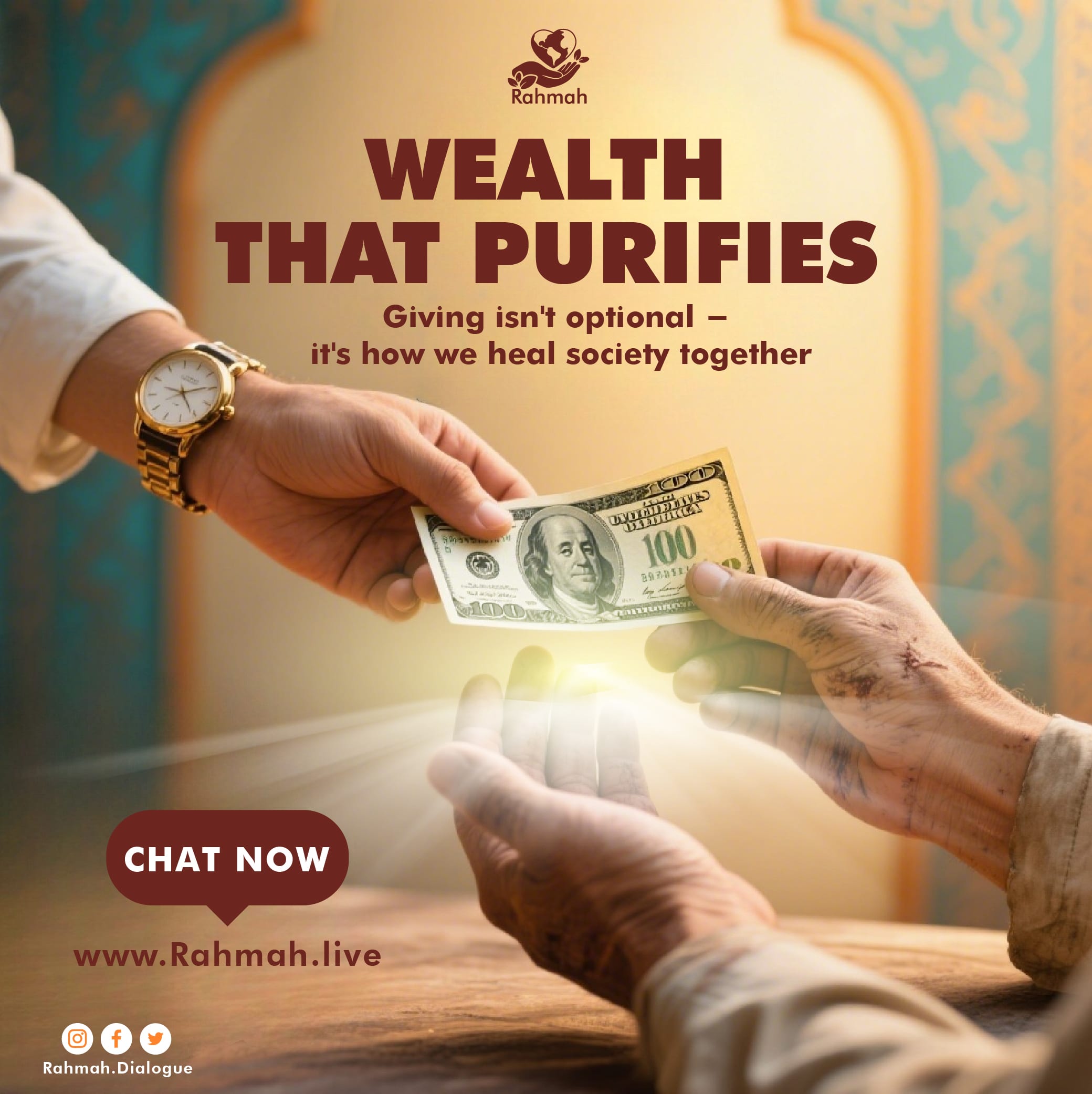
Introduction: Is Wealth a Private Right or a Social Trust?
In a world driven by materialism, where the gap between extreme wealth and deep poverty is widening, an urgent question arises: How can money be a tool for building rather than a means of control? In the “Tree of Faith,” Zakat (الزكاة) represents growth and flow.
It is the pillar that transforms “private ownership” into “social responsibility.”In Islam, Zakat is not just a casual “donation” given by the rich to the poor. It is a “known right” and an institutional duty aimed at rebalancing society and purifying both the soul and the wealth.
The Philosophy of Zakat: Purification and Growth
The word Zakat (زكاة) in the Arabic language carries two profound meanings: Purification and Growth. This summarizes its deep philosophy:
- Purification of the Soul (Tathir/تطهير): It is the cure for “greed” (Shuhh/شح)—the sickness that makes a person a prisoner to what they own. Zakat frees the wealthy from the slavery of material things and cleanses the heart of the needy from feelings of exclusion or envy.
- Growth of Society (Nama’/نماء):Zakat rejects the “hoarding of money” in vaults. It forces wealth to circulate through the veins of society, refreshing the economy, creating opportunities, and turning money from “frozen power” into “active energy” for good.
Zakat as a Universal Safety Net
Islam has defined eight categories (Masarif/مصارف) for spending Zakat, which together represent a complete “social insurance” system:
- Caring for the Needy: Providing enough for the poor (Fuqara’/فقراء) and the needy (Masakin/مساكين) to live with dignity.
- Freeing the Human Being: Whether from the chains of debt (Gharimin/غارمين) that break a person’s spirit, or from any form of dependency or modern slavery.
- Supporting Stability: Helping travelers who are stranded (Abn al-Sabil/أبناء السبيل) and ensuring aid reaches anyone who has lost their means of living. This precise organization ensures that Zakat is not a random gift, but a professional way of managing societal crises.
The Social Impact: A Society Like One Body
When a society applies the duty of Zakat, it moves from “hostile competition” to “merciful integration”:
- Reducing Class Gaps: Zakat does not fight wealth; it fights poverty. It allows for individual success but ensures that no one is left behind.
- Social Peace: When the needy realize their rights are protected within the wealth of the capable, feelings of belonging grow. Society becomes like a “solid structure” where each part supports the other.
- Institutional Responsibility: Today, Zakat has evolved into organizations and humanitarian projects (education, health, clean water), proving that this system works for every time and place.
Conclusion: Wealth in the Service of Humanity
Giving Zakat is the practical proof of true faith. Whoever can defeat their desire for ownership to help others has reached a peak of human nobility. It is a call to redefine “financial success” to be measured by how much we give, not just how much we collect.
We invite you to reflect on this unique financial system: How could a small percentage (2.5%) of surplus wealth solve the world’s biggest poverty problems? How can faith-based values create an economy that puts the “Human Being” above all else?
 English
 Español
 Português do Brasil
 Français
 Português
 Tagalog
 日本語
日本語 简体中文
简体中文 Русский
 Italiano
 Deutsch
 Türkçe
 العربية