
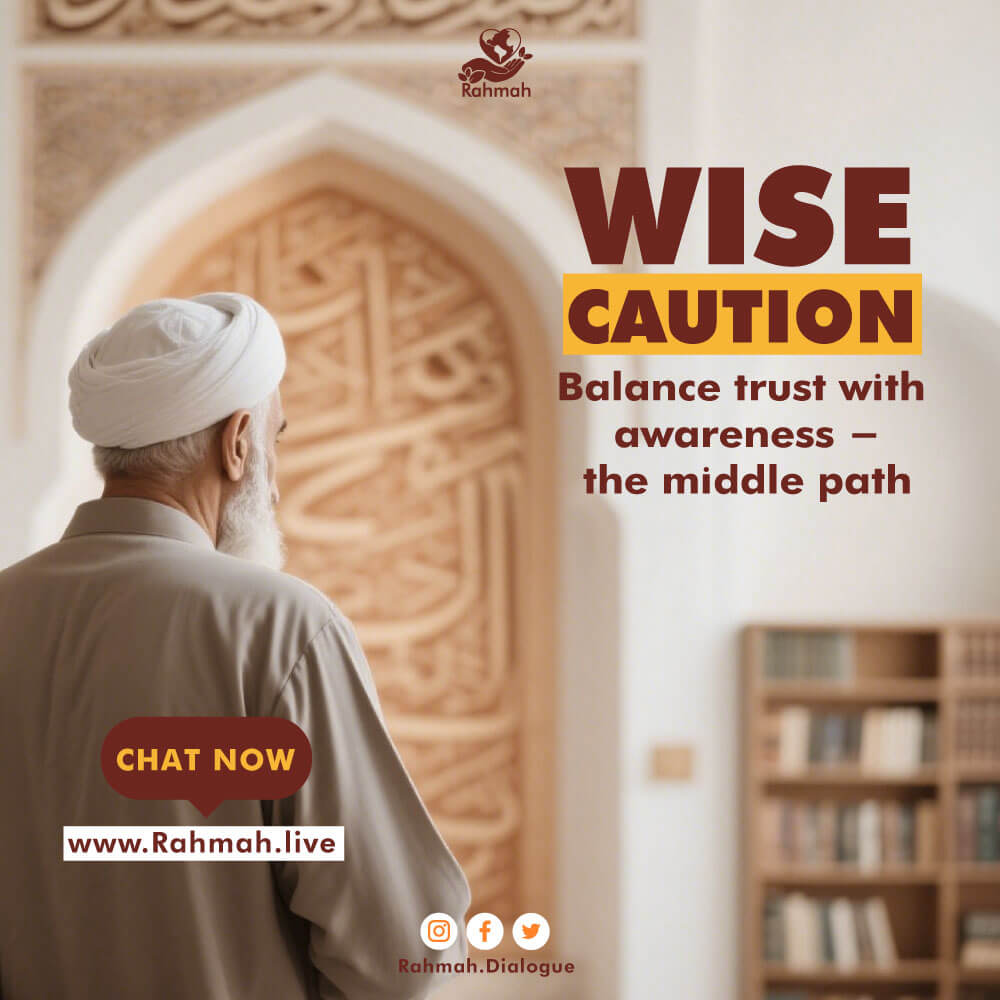
Introduction: Does Caution Contradict True Reliance on God?
Some mistakenly believe that Tawakkul (trusting God after doing our part) means neglecting practical steps and leaving things to chance. However, Islam offers a deeper vision that combines a heart at peace through reliance on the Creator with an alert mind that deals with life’s requirements. In the “Tree of Faith,” caution and precaution represent “Constant Readiness.” A tree does not grow by merely waiting for rain; it must strike its roots deep into the earth and protect its trunk from external threats.
Caution in Islam is a “Practical Worship” that protects a person from negligence. It makes the believer an active, intelligent being who understands the laws of the universe. He does not throw himself into danger claiming “destiny,” but rather uses God’s laws to protect himself from God’s decrees.
The Philosophy of Caution: “Tie Your Camel and Trust in God”
The Prophet ﷺ formulated a comprehensive rule when he told a man asking about his camel: “Tie it and trust in God” (I’qilha wa tawakkal). This principle is built on solid spiritual foundations:
- Prevention as a Legal Root: The objectives of Sharia—preserving religion, life, intellect, lineage, and wealth—cannot be achieved without precaution. Guarding against illness, protecting wealth from loss, and being wary of harm are all acts of worship.
- Alertness and Rejecting Negligence: A believer is not bitten from the same hole twice. Caution develops “Intuition” (Firasah/فراسة) and the ability to foresee consequences. It moves the individual out of the circle of heedlessness.
- Preparation as a Value: God commanded believers in many situations to be cautious and prepared, proving that precaution is not “fear” but “readiness.”
Caution in Life’s Paths: Integrity and Growth
This branch of faith manifests in daily practices, making life more disciplined:
- Protecting Financial Trusts: Being cautious in contracts, documenting debts, and avoiding financial ambiguities are acts of obedience to God to prevent future conflicts.
- Preserving Body and Soul: Health caution by avoiding harmful substances, and intellectual caution by staying away from misleading ideologies, are part of fulfilling the “Trust of the Body and Mind.”
- Psychological Balance: Faith-based caution does not lead to anxiety; it brings the “Tranquility of the Prepared.” The believer exerts every effort in precaution, then surrenders the outcome to God with contentment.
Social Impact: A Society of Safety and Stability
When conscious caution prevails, society grows in a resilient environment:
- Reducing Disasters: A cautious society experiences less negligence and recklessness, preserving lives and property.
- Mastery of Work (Itqan/إتقان): Caution pushes people toward precision and planning, raising the quality of work and building the nation’s economic strength on solid ground.
- Responsibility: Newer generations grow up realizing that Tawakkul is not helplessness, and that success is the fruit of “Sincere Intention and Mastered Work.”
Conclusion: Caution is Certainty and Action
The branch of caution is a call to reject “Passive Reliance” (Tawakul) and rise toward true Tawakkul (Active Reliance). It tells us that a seeing eye and a working hand are the two wings of a believer. Whoever takes the means as an act of worship and trusts in God with sincerity has grasped the most trustworthy handhold.
We invite you to reflect on this unique balance: How can precaution increase a person’s tranquility instead of their anxiety? And how do the values of “taking the means” contribute to building a cohesive Islamic society characterized by strength, awareness, and justice?





 English
 Español
 Português do Brasil
 Français
 Português
 Tagalog
 日本語
日本語 简体中文
简体中文 Русский
 Italiano
 Deutsch
 Türkçe
 العربية