
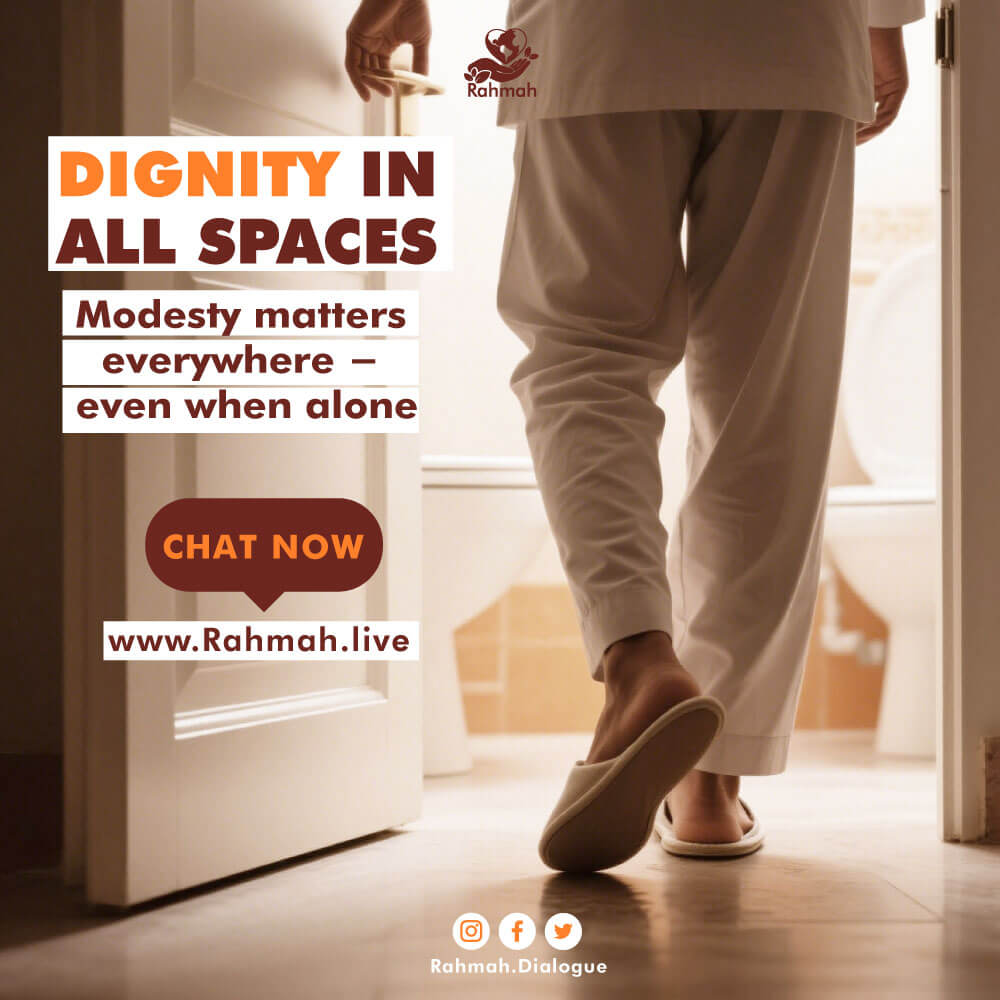
Introduction: Does Modesty Vanish When Eyes Are Away?
In Islamic Sharia, modesty (Haya’/حياء) is not merely a garment we wear in front of people; it is an “Internal Character” that accompanies the believer in private and in public, at home and in public spaces. In the “Tree of Faith,” the branch of “Not Entering Public Baths Except with a Waist-Wrap (Mi’zar)” represents the “Peel that Protects the Fruit.” It safeguards the body’s dignity and prevents the desecration of private areas. Islam has made concealment in washrooms a sign of perfect certainty in God, who sees and hears everything.
Adhering to the Mi’zar (a garment that covers the private parts) in bathing areas is not just a hygienic measure; it is an “Act of Worship” and a veneration of the human self, preventing it from being cheapened by exposure before others.
The Philosophy of Concealment: “Allah is More Deserving of Modesty”
The Prophet ﷺ established the rule of modesty in privacy when asked about our private parts (‘Awrah), saying: “Allah is more deserving than people that one should be modest before Him.” This etiquette in public baths rests on firm spiritual pillars:
- Connection to Faith: When the Prophet ﷺ said: “Whoever believes in Allah and the Last Day, let him not enter a public bath except with a waist-wrap,” he made this behavior an extension of creed. A sincere believer does not compromise their modesty for a worldly purpose.
- Blocking the Means to Temptation: Looking at private parts is a gateway to immorality. Maintaining concealment in shared washrooms blocks the path of temptation and protects hearts from ill thoughts.
- Emulating Angelic Traits: The believer seeks to elevate their soul. Modesty is a character that aligns with the dignity and concealment inherent in the nature of angels, distinguishing humans from other creatures.
Etiquette of the Washroom: The Believer’s Dignity in Private States
This branch manifests in a believer’s conduct, creating a person of chastity and gravity:
- Covering the Primary Private Parts: Total commitment to covering the area between the navel and the knees in shared spaces, and ensuring one’s gaze does not fall on the private parts of others, in compliance with the Divine command to “lower the gaze.”
- Adhering to Entry and Exit Etiquette: Mentioning the name of God upon entering places of privacy and bathing, asking for concealment and wellbeing (‘Afiyah), which links a mundane daily act to the constant remembrance of the Creator.
- Respecting Privacy: Avoiding prying or attempting to see what others have hidden. Just as a believer loves to be covered, they must cover others.
Spiritual and Social Impact: A Society of Purity and Dignity
When the character of concealment and modesty prevails in the finest details of hygiene, magnificent gains are achieved:
- Growth of Gallantry (Muru’ah): Concealment grants the soul a sense of “pride” and dignity, making a person value themselves and reject vulgarity, which reflects on their conduct in all life affairs.
- Sovereignty of Mutual Respect: When individuals respect the sanctity of each other’s bodies, a spirit of “veneration” grows in society, and crude behaviors that scratch public modesty vanish.
- Protecting the Primordial Nature (Fitrah): This branch preserves the “Healthy Fitrah” of children and youth, as they become accustomed from a young age to the fact that the body has a sanctity and that modesty is an ornament that never leaves a believer.
Spiritual Accountability: “Allah is the Concealer and Loves Concealment”
This branch calls us to magnify the value of concealment in our contemporary life:
- Modesty in Clubs and Sports: Committing to concealment when practicing activities that require lighter clothing, maintaining an Islamic character that combines strength with chastity.
- Raising Children on Decency: Planting the concept of ‘Awrah and the necessity of concealment in the hearts of the youth, so that modesty becomes an innate trait.
Conclusion: Modesty is Entirely Good
The branch of not entering a washroom except with a waist-wrap is a powerful message that Islam cares for human dignity in every state. It is a call to spread a culture of “Concealment” that protects souls before bodies. Whoever covers themselves with God’s concealment, God dresses them in the robe of dignity and acceptance in this world and the next.
We invite you to reflect on this moral elevation: How can modesty in the finest details build a respected personality and a pure society? And how do the values of “Chastity and Concealment” contribute to building a cohesive Islamic society ruled by justice, affection, and peace?
 English
 Español
 Português do Brasil
 Français
 Português
 Tagalog
 日本語
日本語 简体中文
简体中文 Русский
 Italiano
 Deutsch
 Türkçe
 العربية